Why Children Love Stories About Themselves (And What It Does for Their Development)
Children react to personalized storybooks like nothing else. Here's the psychology and neuroscience behind why — and what it means for their confidence, empathy, and love of reading.
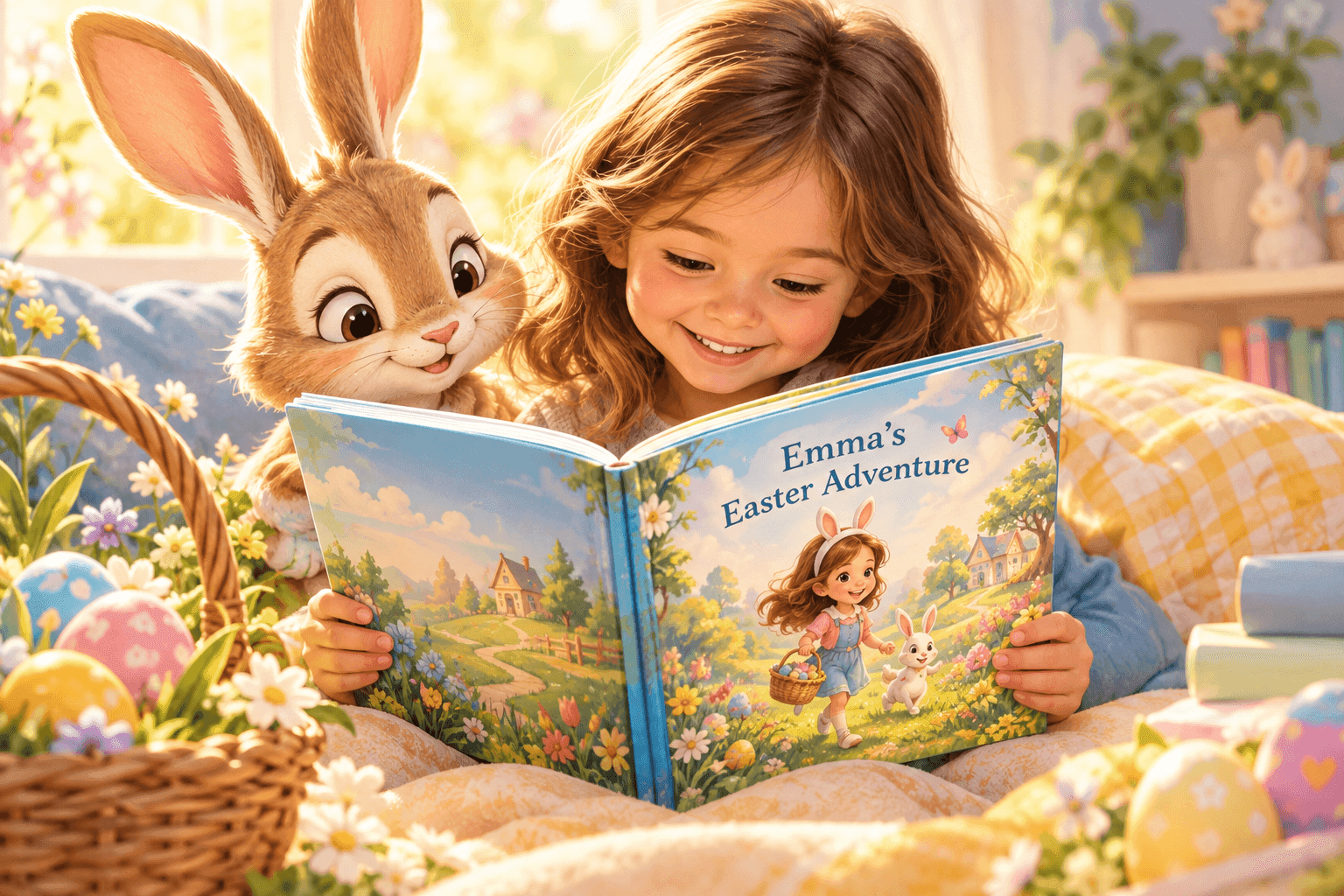
Ask any parent who has read a personalized storybook to their child and you'll hear the same thing: the reaction is unlike anything else.
Not the polite interest they show for a library book. Not the mild engagement of a familiar favourite. Something different — a sharp intake of breath, a wide-eyed look, a "that's me" said with a mixture of delight and disbelief.
Children who are handed a book starring themselves don't just read it. They experience it. They return to it. They ask for it by name.
Why? What is it about seeing yourself in a story that produces such a powerful response — in children especially? And what does that response actually do for a child's development?
The answers are more interesting than you might expect.
The mirror effect: why self-recognition is so compelling
From the very earliest stages of development, children are drawn to their own reflection. Babies as young as a few months show heightened attention to mirrors. By 18 months, most children can recognize themselves — a milestone developmental psychologists treat as a marker of emerging self-awareness.
That pull toward self-recognition doesn't fade as children grow. If anything, it intensifies. The question who am I? is the defining question of childhood and adolescence, and children are constantly scanning their environment — faces, stories, images, conversations — for mirrors that help them answer it.
A story about themselves is the most direct mirror a child can find.
When a child opens a book and sees a character with their name, their face, their favourite colour, their beloved pet — something neurological happens that goes beyond entertainment. The brain's self-referential processing network activates. The story stops being something happening to someone else and becomes something happening to them.
This is why the reaction is so visceral. It's not excitement about a good book. It's the thrill of being seen.
"I matter enough to have a story"
There's an emotional dimension to this that's easy to overlook.
Stories carry cultural weight. Children understand, even before they can articulate it, that stories are how a society says: this person, this experience, this life — matters. We tell stories about the people and things we value.
When a child receives a story about themselves — particularly one made specially for them by a parent or grandparent — the implicit message is profound: You are interesting enough to be the hero. Your name belongs on the cover of a book. Your adventures are worth telling.
For children with developing self-esteem, that message lands deeply. It's not flattery. It's recognition. And recognition, at the right moment in childhood, can shape how a child sees themselves for years.
"My son has always been quite shy and unsure of himself. After we made him a storybook where he was the brave explorer, he started calling himself 'the brave one' in real life. It's been months and he still does it." — Parent from the LuluStories community
What the research tells us about self-referential stories
Developmental psychologists have studied the effect of personally relevant content on children's learning and engagement for decades. The findings are consistent:
Children comprehend more when they're emotionally invested. When a story features familiar names, places, or experiences, comprehension scores improve significantly compared to equivalent stories with unfamiliar content. The brain allocates more resources to processing information it identifies as personally relevant.
Self-referential content is remembered better. The "self-reference effect" — first identified in adults in the 1970s — has since been demonstrated in children as young as four. Information processed in relation to the self is encoded more deeply and recalled more accurately than information processed in other ways. A child who reads a story about themselves will remember it longer than a story about a stranger.
Emotional engagement amplifies learning. Stories that produce emotional responses — joy, surprise, tension, relief — produce stronger neural encoding than emotionally neutral content. A personalized story that makes a child gasp with recognition and then laugh and then worry for the character and then cheer — is doing more cognitive work than almost any other reading experience.
Put these three effects together and you have a powerful case not just for why children love stories about themselves, but for why those stories are especially good for them.
The identity-building function of personal stories
Childhood is fundamentally a process of constructing a self. Children are constantly asking — implicitly, through play and questions and the stories they choose — questions like: What kind of person am I? What am I capable of? What do I value? How do others see me?
Stories are one of the primary tools through which children explore these questions. When a child plays hero in a game, reads about a brave character, or imagines themselves in an adventure, they are trying on possible selves — testing versions of who they might be.
A personalized storybook accelerates and deepens this process because it doesn't ask the child to make the imaginative leap of inserting themselves into someone else's story. It places them directly into a narrative where their identity is already the starting point.
The child who reads a story in which they are curious and brave and kind doesn't just enjoy the fantasy. They absorb it as information about who they are. Stories we tell children about themselves have a way of becoming true — not because of magic, but because of the quiet, persistent power of narrative to shape self-concept.
Why personalized stories work especially well for reluctant readers
For children who find reading difficult or uninteresting, the self-referential effect is particularly powerful.
Reading requires sustained effort, especially in the early years. For a child who is still decoding rather than fluently reading, a book has to offer something compelling enough to be worth the work. A generic story about characters they don't know and situations they can't relate to often isn't compelling enough.
A story about themselves is different. The motivation to know what happens to them — to see what adventure they go on, how they solve the problem, what the illustrations of their face look like on the next page — can override the resistance that struggling readers typically feel.
Parents regularly tell us that children who flatly refused to engage with books will sit through a personalized storybook not once but multiple times. The content hasn't changed their reading ability. But it has changed their willingness to try.
That willingness — the moment a child decides reading might be for them after all — is often the turning point everything else follows from.
The lasting effect: stories we tell children about themselves
There's one more dimension worth considering.
The stories adults tell children about themselves — not just in books, but in conversation, in how they describe them to others, in the qualities they notice and name — shape how children understand themselves. "You're the curious one." "You're so kind to your friends." "You're the brave explorer of this family." These narrative labels stick.
A personalized storybook is, in a sense, a concentrated version of this. It's a parent or grandparent saying: here is a story that captures something true about you — your name, your face, your spirit. Here is the adventure that belongs to you.
Children don't just read those stories. They carry them.
At LuluStories, we've built the platform around this insight. Every story we generate is built from the real details of a real child — their photo, their name, their interests, their world. The result isn't just a book. It's a mirror, a message, and a memory all in one.
Create a free personalized story starring your child →
How to make the most of a personalized storybook
If you're creating a personalized story for your child — or choosing one as a gift — here are a few things that deepen the impact:
Read it together the first time. The moment of recognition — "that's me!" — is one you want to share. The first read-through is an event, not just a bedtime routine.
Let them hold it. For younger children especially, the physical experience of holding a book that has their face on the cover is significant. Let them carry it, show it to people, bring it to nursery if they want to.
Talk about what happened. After reading, ask what their favourite part was, what they'd do differently, what happens after the story ends. This extends the engagement and deepens the self-referential processing.
Return to it. Unlike most books, personalized storybooks tend to grow with the child rather than being outgrown. A five-year-old reading their own story finds different things to notice than they did at three. It's worth revisiting.
The bottom line
Children love stories about themselves because being seen — really seen, named, illustrated, made the hero of an adventure — meets one of the deepest needs of childhood: the need to know that you matter.
That need doesn't go away. But the window when a storybook can meet it so completely, so joyfully, so memorably — that window is childhood. And it moves faster than any parent expects.
If you've been thinking about creating a personalized storybook for your child, there's no better moment than now. The first story is free, it takes five minutes, and the reaction when they see themselves on the first page is something you won't forget either.
Create your child's personalized storybook — free to start →
Related posts: · Why Reading Is One of the Best Things You Can Do for Your Child's Brain · How to Get Kids Excited About Reading · The Best Personalized Birthday Book for Kids
Ready to create your child's own storybook?
Turn your child into the hero of a fully illustrated, personalized story in minutes.