Preparing Children for a New Sibling
Learn how stories can help children prepare for a new sibling.
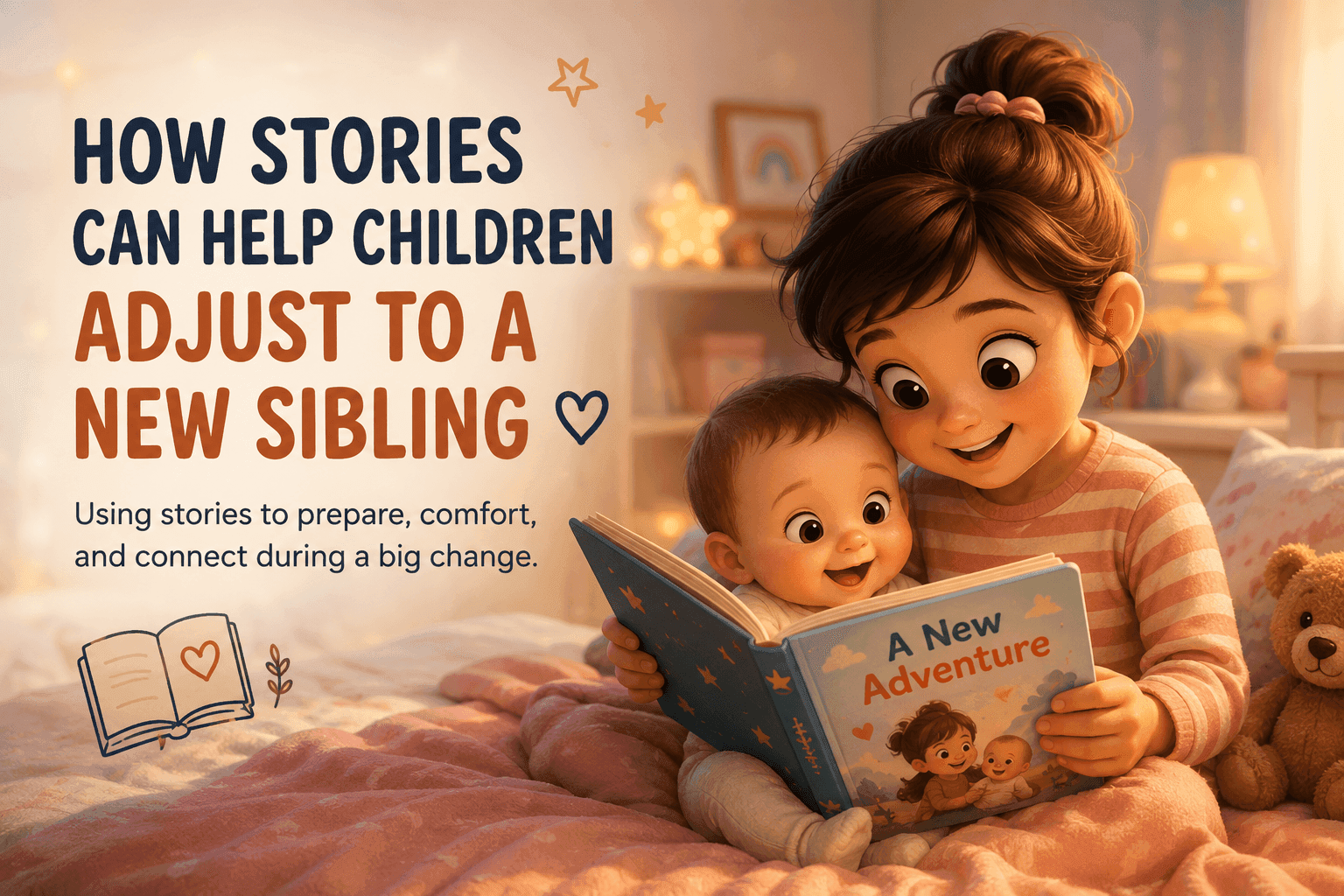
How Stories Can Help Children Adjust to a New Sibling
Welcoming a new baby into the family is an exciting time, but it can also be a big change for an older child.
A child who has been used to having their parents' attention may suddenly have to share that attention with a newborn. They may feel excited, curious, proud, confused, or even jealous. These reactions are normal, and helping children understand what is happening before the baby arrives can make the transition easier.
One simple way parents can prepare their child is through stories.
Stories give children an opportunity to explore new experiences in a safe and familiar way. A story about becoming a big brother or big sister can introduce ideas such as sharing, helping, waiting, and welcoming a new family member before those situations happen in real life.
Why stories can help children prepare for a new baby
Children often understand new experiences more easily when they can see them through characters and situations they recognize.
A story about a new sibling can help introduce concepts such as:
- What a newborn is like
- What it means to become a big brother or sister
- Why babies cry
- How parents may need to spend time caring for the baby
- Ways an older child can help
- How the family routine may change
- How everyone can still spend special time together
The American Academy of Pediatrics recommends reading children's books about newborns and siblings as one way to help older children become familiar with the idea of a new baby. UNICEF also recommends reading or telling stories about becoming a big brother or sister when preparing young children for a new sibling.
Stories should not be expected to solve every emotional challenge, but they can give children a familiar framework for talking about what is coming.
Choose stories that match your child's age
The best story for a toddler will be different from the best story for a school-aged child.
Toddlers
Young children may not fully understand what it means to have a new sibling. Keep stories simple and focus on familiar ideas.
You might talk about:
- A baby coming home
- What babies eat
- Why babies sleep and cry
- Giving the baby gentle cuddles
- Being a big brother or sister
Repeating the same story can also be helpful. Young children often enjoy hearing familiar stories many times.
Preschoolers
Preschoolers can usually understand more about the changes that are coming.
Stories can introduce situations such as:
- Meeting the baby for the first time
- Helping parents with simple tasks
- Sharing attention
- Waiting while the baby is being fed
- Having special time with a parent
- Feeling happy and sometimes frustrated
This can give parents natural opportunities to ask questions and discover how their child feels.
School-aged children
Older children can explore more complex emotions and situations.
A story could focus on friendship between siblings, responsibility, changes to family routines, or how an older child can have an important role without becoming responsible for caring for the baby.
The goal is not to make the older child feel responsible for the newborn. Instead, stories can help them understand that they are still an important part of the family.
Let your child be part of the story
One of the most engaging ways to prepare a child for a new sibling is to make the story personal.
Instead of reading about a completely unfamiliar family, imagine a story where your child is the main character.
For example:
"Emma was about to become a big sister. At first, she wasn't sure what having a baby at home would be like..."
You can then build the story around situations your child might actually experience.
Ask questions while reading:
- "How do you think Emma feels?"
- "What would you do if you were Emma?"
- "What do you think the baby will be like?"
- "What could Emma do while Mommy is feeding the baby?"
- "What could the family do together?"
There are no right or wrong answers. The conversation itself can help children express their thoughts.
Talk about both the exciting and difficult parts
It can be tempting to make every story about how wonderful having a new baby will be.
But children may benefit from hearing that some things could be difficult too.
A newborn may cry a lot. Parents may sometimes be tired. Routines can change. There may be moments when the older child has to wait.
Being honest in an age-appropriate way can help children develop realistic expectations.
At the same time, emphasize that difficult moments do not mean that anything is wrong.
A child can love their new sibling and still feel frustrated sometimes.
They can be excited about becoming a big brother or sister and still miss having their parents all to themselves.
Both feelings can exist at the same time.
Create a story about your child's own new sibling adventure
Personalized stories can make this experience even more meaningful.
With LuluStories, parents can create a children's story where their child becomes the main character. You can personalize the story with the child's name, interests, characters, themes, and other details.
For example, you could create a story about a child preparing for their new role as a big brother or big sister.
The story could follow the child as they:
- Find out that a baby is coming.
- Help prepare the baby's room.
- Choose something special for their new sibling.
- Meet the baby for the first time.
- Discover what it is like to have a newborn at home.
- Find special ways to spend time with their parents.
- Begin their own adventure as a big brother or sister.
The advantage of a personalized story is that the child can recognize themselves in the experience.
Instead of simply reading about "a child," they can see themselves as the hero of the story.
Combine storytelling with practical preparation
Stories are only one part of preparing for a new sibling.
There are also plenty of practical things parents need to organize before the baby arrives, from clothing and bedding to hygiene products, maternity-bag essentials, and other newborn supplies.
For Brazilian families preparing for a new baby, resources such as Mamii's [baby essentials guide] can be useful when putting together a newborn trousseau and comparing essential items.
Preparing these practical things can also become an activity that includes the older child.
Depending on their age, children might help choose a blanket, organize some baby clothes, pick a book for the baby's room, or help prepare a small gift for their new sibling.
Give your child a special role
Children can feel more involved when they have an age-appropriate role in preparing for the baby.
This does not mean giving them responsibility for caring for the newborn.
Instead, look for small ways they can participate.
For example:
- Let them help choose a baby book.
- Ask them to pick a stuffed animal for the baby's room.
- Let them help organize baby clothes.
- Ask them to draw a picture for the baby.
- Create a special "big brother" or "big sister" story together.
- Let them choose a song to sing to the baby.
Small contributions can help children feel included in the transition.
Keep one-on-one time after the baby arrives
Preparing for the baby is important, but what happens after the birth matters too.
Older children may suddenly receive less one-on-one attention because newborns require so much care.
Whenever possible, parents can create small moments that are just for the older child.
This doesn't need to be a big activity.
Reading a story together before bed, going for a short walk, playing a favorite game, or simply sitting together and talking can provide valuable connection.
A personalized story can become part of this routine.
For example, parents could create a story about the child's first few weeks as a big brother or sister and read one chapter together at bedtime.
Make room for complicated feelings
A new sibling can bring many emotions.
Some children immediately love being a big brother or sister. Others may take longer to adjust.
Some children may become more demanding, clingy, or emotional. Others may seem completely unaffected.
There is no single "correct" reaction.
Parents can reassure their child that it is okay to have different feelings while continuing to show them that they are loved and important.
Instead of saying:
"You shouldn't be jealous."
Try:
"I understand that it can be hard when the baby needs a lot of attention. You are still very important to me."
This gives the child permission to express their feelings without making them feel guilty.
Turn sibling preparation into an ongoing conversation
Preparing for a new sibling doesn't have to happen in one conversation.
Children may think of new questions as the pregnancy progresses.
They might wonder:
- Where will the baby sleep?
- What will the baby eat?
- Will the baby play with me?
- Why does the baby cry?
- Who will look after me when the baby is born?
- Will Mom and Dad still have time for me?
Stories can give parents a natural starting point for these conversations.
Read together, pause when something interesting happens, and let your child ask questions.
The goal isn't a perfect transition
It is normal for becoming a big brother or sister to take some adjustment.
Stories cannot remove every difficult emotion or guarantee that siblings will immediately get along.
What stories can do is give children a safe way to explore an unfamiliar experience before it happens.
They can introduce new vocabulary, familiar situations, emotions, and possibilities.
Combined with honest conversations, practical preparation, and plenty of reassurance, storytelling can become a simple and enjoyable part of preparing your child for a new sibling.
Most importantly, remind your child that while the family is growing, there is still a special place for them.
They aren't losing their role in the family.
They're gaining a new one.
And sometimes, the best way to help a child understand that new adventure is to let them become the hero of the story.
Ready to create your child's own storybook?
Turn your child into the hero of a fully illustrated, personalized story in minutes.