How to Teach Kids to Write Thank-You Notes: A Guide by Age
A simple age-by-age guide to kids' thank-you notes, with a fill-in template, examples to copy, and ideas for children who would rather do anything else.
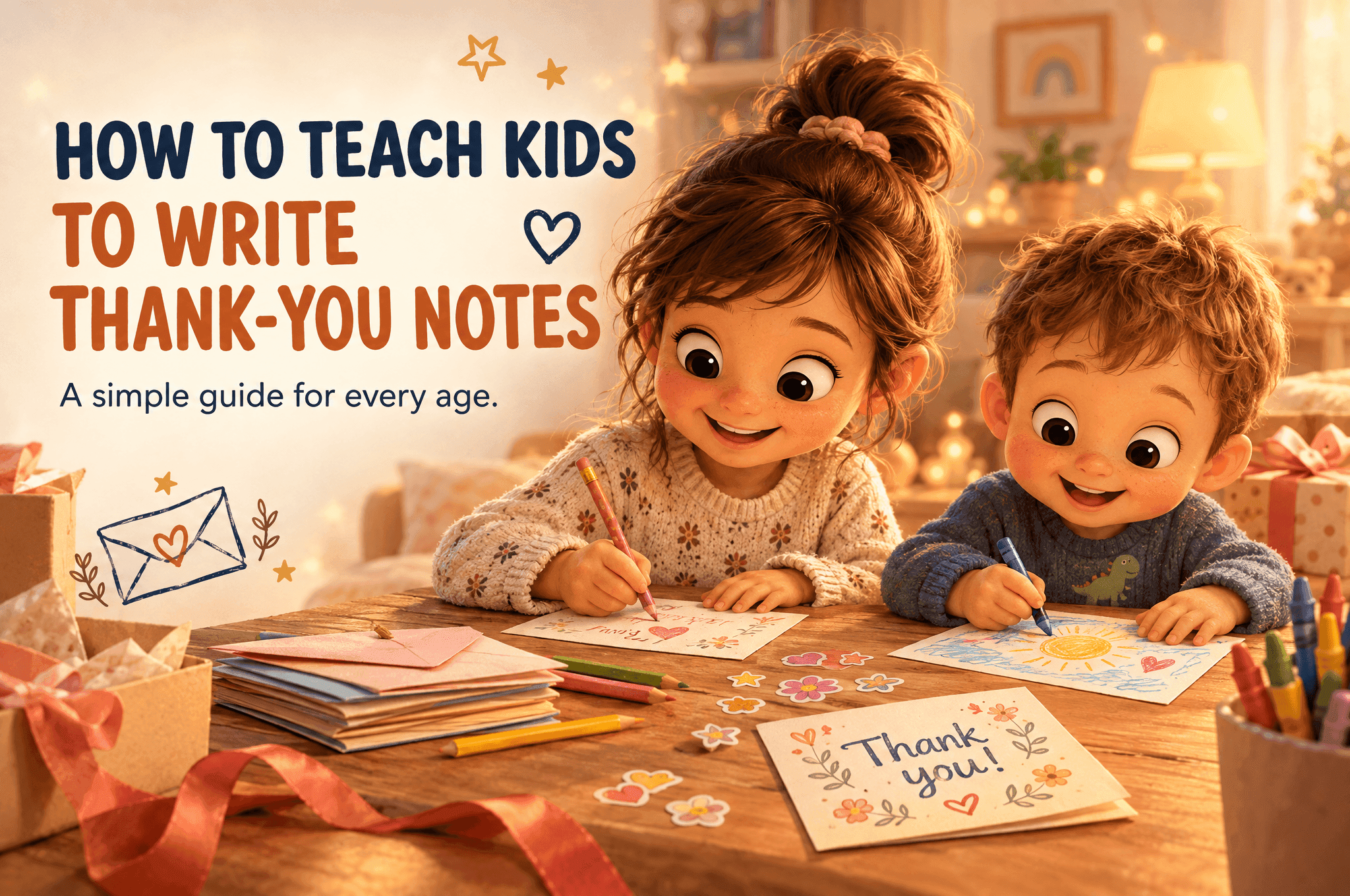
The gifts are open, the wrapping paper is everywhere, and someone has to thank Grandma. If you've ever tried to get a six-year-old to sit down and write a thank-you note, you know it can feel harder than the holiday itself.
It doesn't have to be. A child's thank-you note can be one drawing, or one sentence. What matters is that your child stops to think about the person behind the gift.
This guide covers what to expect at each age, a template your child can fill in, examples to copy, and what to do when they simply don't want to.
Why Thank-You Notes Are Worth the Effort
A thank-you note is more than good manners. It's a small, practical lesson in noticing what someone else did for you.
The Raising Grateful Children project at the University of North Carolina at Chapel Hill studies how parents teach gratitude. Its researchers describe gratitude as more than the words "thank you." Children notice what they've been given, think about why they received it, feel something about it, and then do something to show it.
A good note walks a child through all four:
- Notice: "Aunt Maya sent me a telescope."
- Think: "She remembered that I love space."
- Feel: "That makes me happy."
- Do: "I'll tell her what I saw through it."
You can use these same four steps as questions when your child gets stuck.
Thank-You Notes by Age: What to Expect
Every child develops at a different pace, so treat these stages as a starting point. A note from a child who finds writing hard is just as good when it's shorter.
Ages 2 to 3: Draw and Dictate
Toddlers can't write a note, but they can take part. Ask, "What do you like about your new truck?" and write down the answer in their own words. Then let them scribble or add a sticker.
Thank you for the truck. It goes fast. Love, Theo
Ages 4 to 5: Say It and Sign It
This is a good age to start the habit. Your child tells you what to say, you write it, and they sign their name. If they can copy a word or two, let them. Drawing the gift is often their favorite part.
Dear Grandpa, thank you for the puzzle. I did it with Daddy. It has a whale. Love, Nora
Ages 6 to 8: Write With a Template
Most children this age can write a short note with some help. Give them the template below, spell words when they ask, and leave their spelling mistakes alone. A wobbly note in their own handwriting is what the recipient will love.
Dear Aunt Maya, thank you for the telescope. I saw the moon and it has holes in it. I want to show you when you come. Love, Sam
Ages 9 and Up: Write It Themselves
Older children can plan and write a note by themselves. Encourage them to add one real detail, such as how they used the gift or a question for the person. If they have a long list, help them plan it rather than taking it over.
Dear Uncle Leo, thank you for the sketchbook. I've already filled ten pages with drawings of dragons, and I'm working on a comic now. I'll bring it when we visit in March so you can read it. Love, Ella
A Simple Template Kids Can Fill In
Copy this onto a sheet of paper, or write it out for your child to follow:
Dear (name),
Thank you for (the gift).
I like it because (one reason).
I used it to (what they did with it).
Love, (your child's name)
A handy rule of thumb for length is about one sentence for every two years of age. A six-year-old writes three sentences and they're done.
Examples for Tricky Situations
For money or a gift card: Say what it's for, not how much it was.
Dear Nana, thank you for my birthday money. I'm saving it for a new bike. Love, Jay
For a gift they didn't love: Thank the person for the thought. There's no need to pretend.
Dear Aunt Rosa, thank you for thinking of me and sending a sweater for winter. I hope I see you soon. Love, Mia
For a friend's birthday party gift: Keep it to one or two lines.
Dear Leila, thank you for the art set and for coming to my party. I liked playing tag with you. From, Adam
For someone who did something kind: Notes aren't only for gifts. A teacher, coach, or neighbor will love one too.
Dear Mr. Lee, thank you for helping me with fractions. I got better at them because of you. From, Ava
What to Do When Your Child Won't Write
A reluctant writer is normal. A few things usually help:
- Keep the session short. Write two or three notes, then stop. Finishing the list across a few days beats one long battle.
- Do it together. Sit down and write your own notes at the same table. Children copy what they see far more than what they're told.
- Try "note, then play." Some families ask children to thank the person before a new gift is opened or used. Others find this adds pressure, so choose what suits your child.
- Make it fun. Use stickers, colored pens, or a photo of your child with the gift.
- Let them choose the format. A drawing or a short video call still gives thanks. If handwriting is hard for your child, dictating is a real and useful alternative.
- Don't correct everything. Fixing every letter tells your child the note is a test. Save the corrections for schoolwork.
Thank-You Ideas Beyond a Paper Note
Notes work best as part of a wider family habit. The UNC researchers found that lessons about gratitude tend to happen in everyday conversation, not in big sit-down talks. Try these:
- Share one thing at dinner. Each person names something someone did for them today.
- Make a gratitude jar. Add a slip of paper each week and read them together at New Year.
- Read stories about kindness. Children take in big ideas more easily through a story, especially when the story is about them.
- Make a thank-you story. Create a short personalized story with LuluStories where your child and Grandma go on an adventure together, then share it as a thank-you. For inspiration, try our personalized story ideas for kids.
When the Thank-You List Is Long
A child can manage five or six notes. After a big birthday party, a first birthday, or a baby shower, the list can easily reach 30, and that's usually when parents end up doing the whole thing themselves.
There's no rule that says every card has to be handwritten by a child. One option is to keep the handwritten notes for the people closest to your child, and let a service handle the rest.
ShipNote is built for exactly this job. You paste in your gift list or registry, write one message, and it personalizes each card with the giver's name and gift. It then prints, addresses, stamps, and mails real postcards for you. The cards are printed rather than handwritten, and it currently mails within the US only. You can still keep your child involved by asking them what to say, then using their words.
ShipNote's guides are also useful if you're stuck for words, including birthday thank-you cards for kids' parties and what to write in Christmas thank-you cards.
Frequently Asked Questions
At what age should kids start writing thank-you notes?
They can take part from around age 2 or 3 by drawing a picture or telling you what to say. Many children can sign their name by 4 or 5, and write a short note with help by 6 to 8.
How soon should a child send a thank-you note?
Within a couple of weeks is a good goal. If you've missed that, send it anyway. A late note is still better than no note.
What should a child's thank-you note say?
Name the person, name the gift, and add one true detail about why they like it or how they used it. Two or three sentences is plenty for most young children.
Do kids need to write a note for every gift?
Not always. If they thanked the person face to face, that may be enough, though grandparents and relatives far away often love something in the mail. Notes matter most when the giver wasn't there to see the gift opened.
Is a text or video OK instead of a card?
Yes, especially for close family. A short video of your child using the gift can be a lovely thank-you. Paper notes are still nice to keep, and they're good writing practice.
What if my child doesn't like the gift?
Help them thank the person for thinking of them, without pretending. It's a useful lesson that the kindness matters even when the gift isn't a favorite.
Small Notes, Lasting Habits
Your child won't remember every note they write. What stays with them is the habit of stopping to think about someone else's kindness, and a grandparent will probably keep that wobbly note in a drawer for years.
Looking for a gift that gets a heartfelt thank-you of its own? Create a free personalized story starring your child with LuluStories, or browse our guide to personalized Christmas gifts for kids.
Ready to create your child's own storybook?
Turn your child into the hero of a fully illustrated, personalized story in minutes.